
STICERD News:
Nobel laureate Philippe Aghion marks official launch of LSE's Huth Initiative for a New Political Economy
Published/Broadcast 13 October 2026
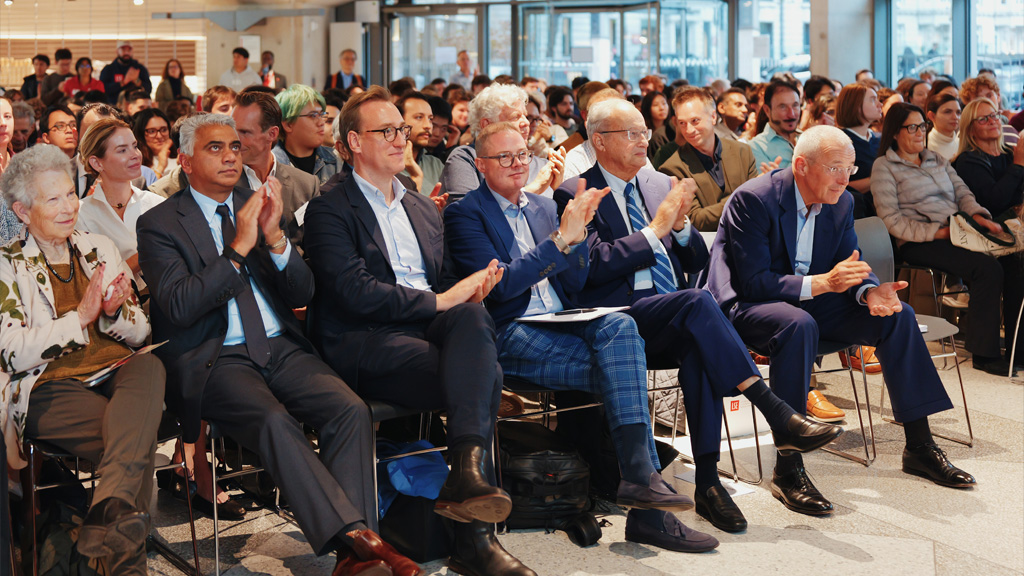
One year on from receiving the Nobel Prize in Economics, Professor Philippe Aghion addressed a full house at LSE with fresh views on AI's potential to boost growth, as the School marked the official launch of the Huth Initiative for a New Political Economy.
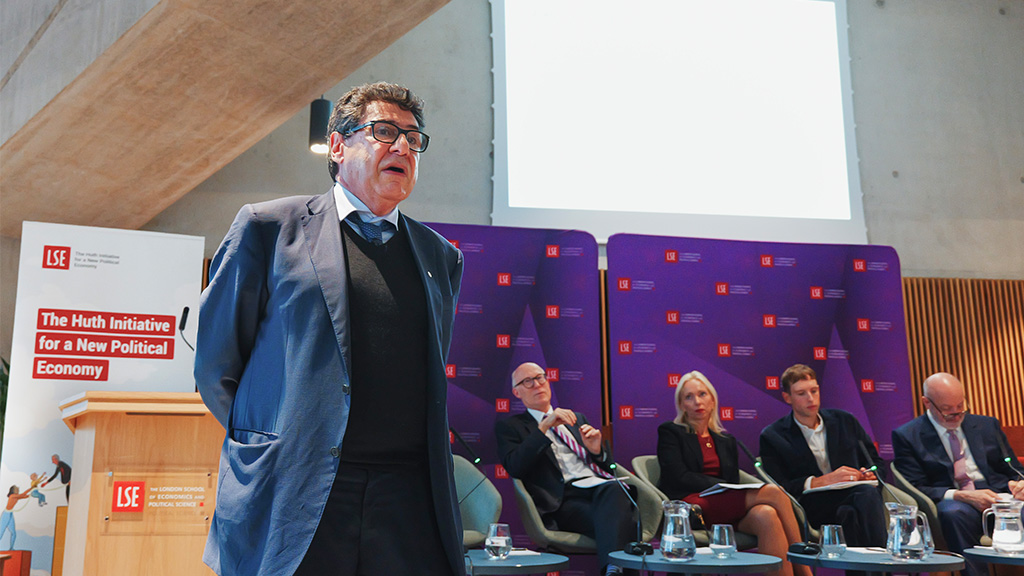
In his lecture, Professor Aghion, known for pioneering Schumpeterian growth theory, struck a balanced note on AI and work. "Of course AI will destroy jobs, but AI has potential for creating new jobs," he said. Unlocking that potential, he argued, depends on getting the policy mix right. "My feeling is that you need this combination, industrial policy, education, flexicurity and other labour market policies, to enhance the growth potential," the Nobel laureate told the audience.
These questions are exactly what the Huth Initiative was created to address.
Enabled by a transformative £10 million gift from LSE alumnus Johannes Huth, the Initiative is a major multi-year programme that brings together leading economists, political scientists and philosophers to develop a new economic paradigm for a fairer, more cohesive society. It aims to offer an alternative to the old economic playbook built on deregulation and globalisation: an economic vision that works for everyone, generates shared prosperity, strengthens democratic life, and treats meaning, community and respect as seriously as material wealth.
In his welcome speech, LSE President and Vice Chancellor Professor Larry Kramer described the Initiative as "LSE in miniature: a highly interdisciplinary collective of scholars bringing the full range of social sciences and their varied methods to bear on a problem of immense public importance." He added: "It will be the tip of LSE's spear as we seek to shape a critically important global debate on the future of political economy."
Professor Aghion was joined by Huth Initiative scholars for a panel discussion that highlighted the need for a new political economy fit for an era of rapid technological change.
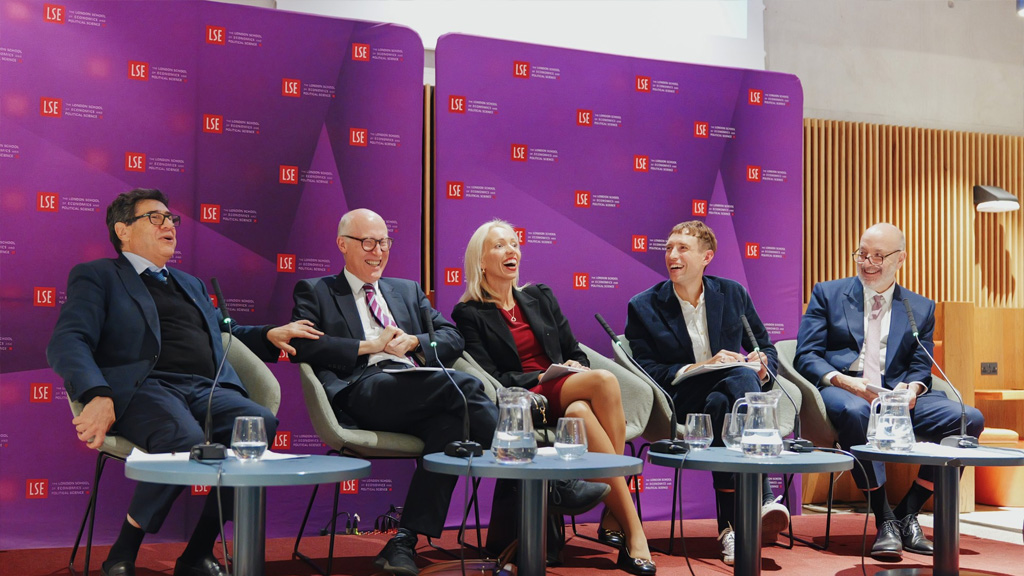
"A lot of the anxieties about AI today are not just about how it will affect the distribution of income, but about a sort of loss of meaning and status and connection, particularly through changes in the world of work," said Dr Daniel Chandler, Executive Director of the Huth Initiative. He highlighted the challenges liberal democratic values face in a time of change, and the need to rethink the institutions required to uphold them.
Building on that, Professor Sara Hobolt, Head of LSE's Department of Government, argued that political institutions are struggling to respond to rapid technological change. "It's a pace that they just can't keep up with," she said.
"And it's not necessarily a kind of change that voters or citizens have built for either, in terms of their responses to it." She warned that those benefiting politically from this upheaval in Europe are often populists, who offer simple solutions but are not well equipped to respond to technological change constructively.
"To have a new political economy, we need to understand not just the brilliant economic models, but also the politics of it: the politics of voters that have emotions, that have fears, that have hopes, and that are all amplified in a time of change," she said.
Sir Tim Besley, Director of the Huth Initiative, posed the harder question facing governments: how to turn vision into reality. "There's too much of just describing a path without describing what it is to make that path a reality," he said. He said a key focus of the Initiative's work would be exploring how to get states functioning well again, so that young people re-engage with democratic institutions and policymaking. Surveys show weakening support for democratic institutions, he noted, particularly among the young. "We do not have a compelling narrative of hope for the younger generation to bring them along."
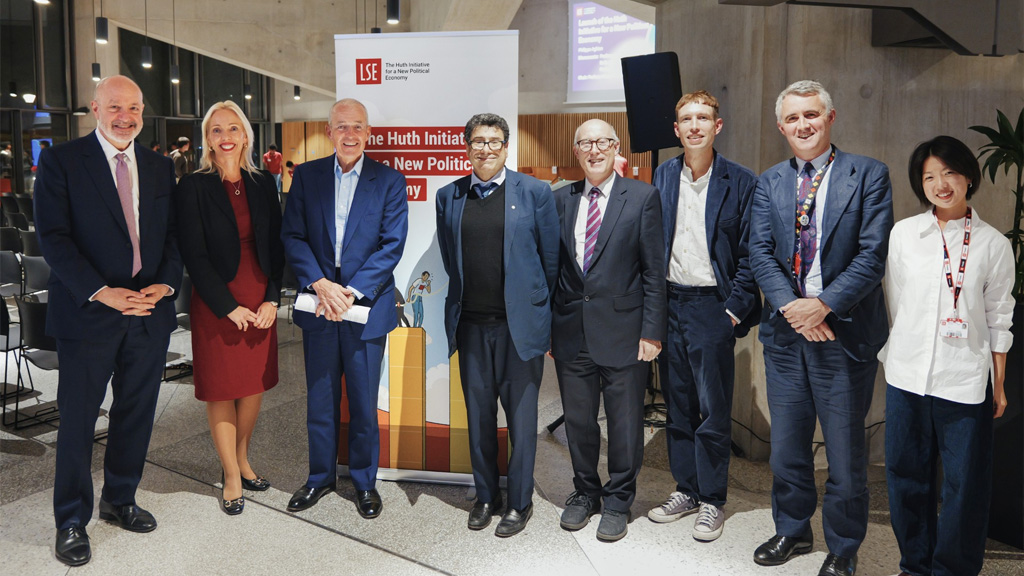
About the Huth Initiative for a New Political Economy
The Huth Initiative for a New Political Economy is a major multi-year programme combining rigorous research with policy engagement to turn ideas into practice. Enabled by a transformative £10 million gift from LSE alumnus Johannes Huth, the Initiative will develop practical frameworks for a fairer, more cohesive economy and lay the foundations for a permanent institute. To learn more about our work, visit the Huth Initiative for a New Political Economy website or subscribe to our newsletter.
Meet the team
- Tim Besley, Director
Tim Besley is School Professor of Economics and Political Science and W. Arthur Lewis Professor of Development Economics at LSE. His research focuses on political economy, development economics and public policy, particularly the role of institutions and governance in shaping economic outcomes. - Daniel Chandler, Executive Director
Daniel Chandler is an economist and philosopher, and Assistant Professorial Research Fellow in the School of Public Policy at LSE. He has worked in the UK Prime Minister's Strategy Unit and at leading think tanks, including the Resolution Foundation and the Institute for Fiscal Studies. - Richard Davies, Policy Director
Richard Davies is an economist and author. He is Professor in Practice at the School of Public Policy, LSE, and was previously economics editor of The Economist and Chair of the Council of Economic Advisers at HM Treasury. - Nikki Sun, Programme Manager
Nikki Sun is a former journalist with over a decade of experience across media, research and public policy. She was previously research and programme manager at the Oxford Martin AI Governance Initiative and a researcher at Chatham House. - Anna Wallace, Programme Coordinator
Anna Wallace holds an MSc in International Development and Humanitarian Emergencies from LSE. She previously worked at the International Growth Centre, an international research centre also based at LSE.
Further events
The Huth Initiative for a New Political Economy will be hosting futher public events including Geography and the wealth of nations (Tuesday 27 October 2026) with Jeffrey Sachs and Challenging inequalities (Tuesday 17 November 2026) with Paul Johnson. For further information on these events and details on how to attend, please visit our events pages.